Version 0.37
Wildlife at your saved spots & 21 more Pacific Northwest natives
October 8, 2026
Added
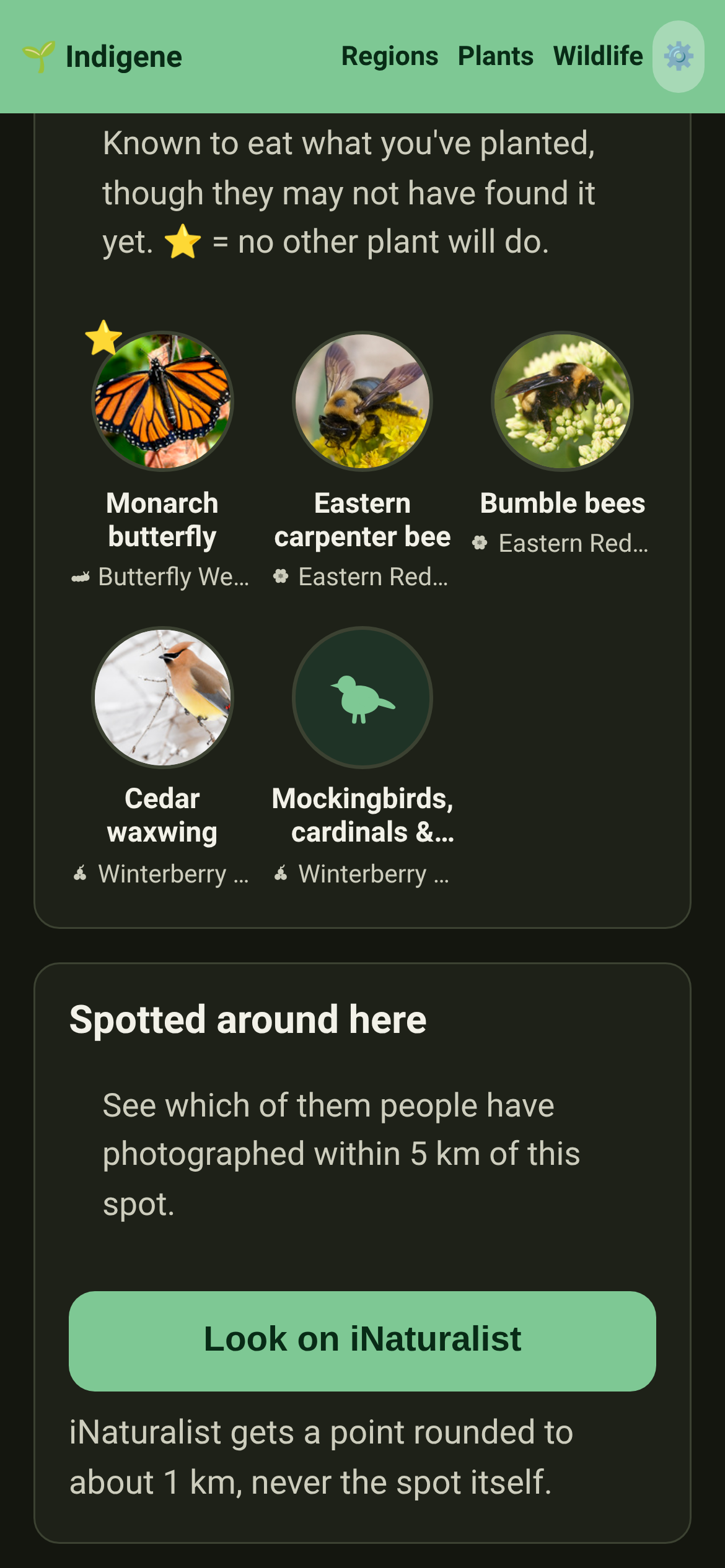
- A saved spot now shows the wildlife in its neighborhood: each animal your plants can feed, with its picture and the plant of yours it eats. Tap one to meet it.
- A saved spot can look for those animals on iNaturalist: a 👀 badge marks the ones seen within 5 km, and photos show who turned up since you planted.
- Saved spots show a row of the animals each garden can feed.
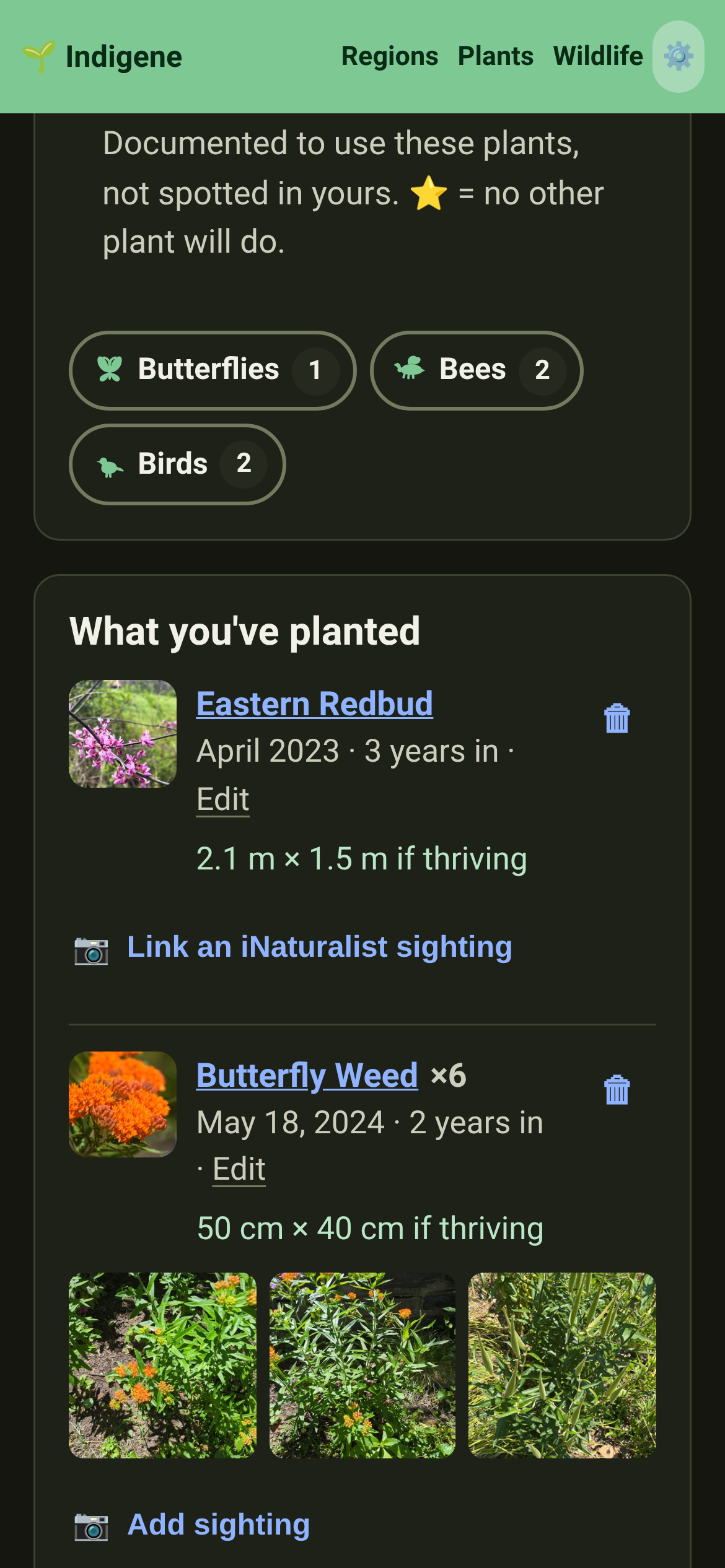
- With your iNaturalist account linked, a saved spot features your own wildlife photos taken within 1 km, and which of your plants might have drawn each one in — "Feeds on your Oregon grape's nectar".
- Matches: when you log a plant in a saved spot, you can pick one of your iNaturalist sightings of it. The sighting gets linked, and its date fills in the planting date. You can still type the details yourself.
- Matches: you can also start from a sighting before choosing a plant. Tap one of your photos on a saved spot's page and Indigene works out which plant it shows. Check the date, then add it.
- Matches: importing from iNaturalist now marks sightings already linked to another spot. A photo of a plant already in the log is added to that entry instead of starting a duplicate.
- Matches: on the location map, press and hold to open a magnifier and nudge the pin a few metres at a time. The line under the map now says which way it moved, like "nudged 40 m northeast".
- Regions: three more native shrubs for the Pacific Northwest — Pacific wax myrtle for a coastal hedge, Oregon boxleaf as a native stand-in for boxwood, and western wahoo for a shady corner.
- Regions: fifteen more Pacific Northwest natives, chosen to fill gaps — late flowers like western goldentop and Pacific aster, Pacific yew and wild ginger for dry shade, and stinging nettle for red admirals.
- Regions: three more Pacific Northwest willows — Pacific willow for a stream bank, coastal willow for dunes and salt wind, and Sitka willow for wet shade. Willows feed more caterpillars than almost anything else here.
- Plants: nettles now carry a "Stings" label, and the "No thorns or stings" filter leaves them out.
- Regions: annuals have their own category, starting with sea blush. Instead of a growth rate, their pages say they last one season and come back from seed.
- A new page on Homegrown National Park, Doug Tallamy's idea that half of America's lawns, given back to native plants, would make a park. It shows where Indigene follows that idea, and why its maker built it.
- Indigene was built with an LLM (a large language model, what most people call AI), and a new page shows the bill: 110 working sessions, about 360 kWh of electricity, and how to use fewer tokens next time.
Changed
- The welcome page's "Why native plants?" now ends by saying what native never means — borders or people — and links to the page that explains it.
Fixed
- Matches: "I planted one" on a plant's page now always arrives with that plant picked, even when it's from another region's list. The search box steps aside once it's picked, so the form no longer looks empty.
- Regions: the Kantō Plain now shows the Japanese flag beside its name, like every other region.
- Matches: on iPhone, holding a finger on the location map no longer starts selecting the text around it, so the map moves the way you'd expect.