Version 0.36
The St Lawrence Lowlands & the Kantō Plain
October 2, 2026
Added
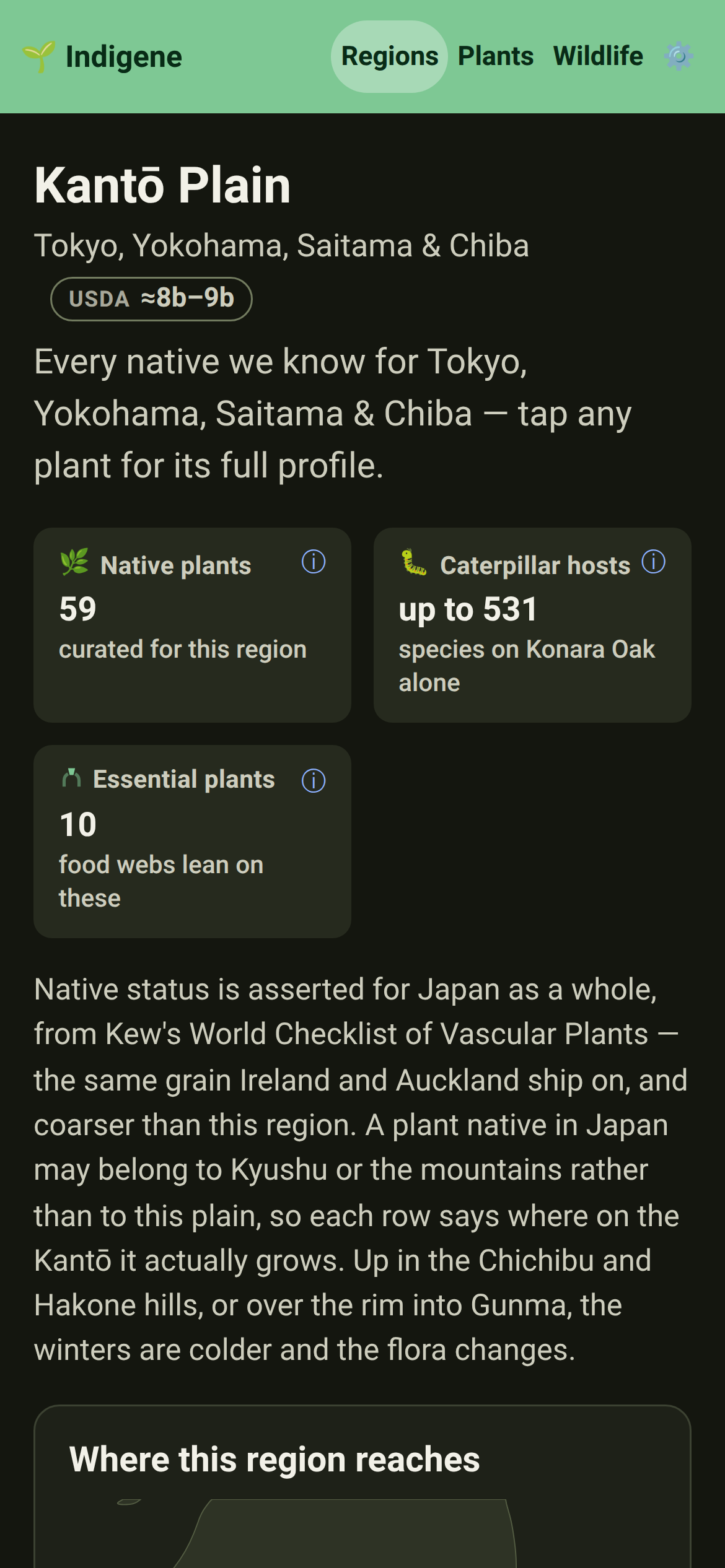
- The Kantō Plain is on the map — 59 native plants for Tokyo, Yokohama, Saitama, Chiba and the country out to Utsunomiya and Chōshi.
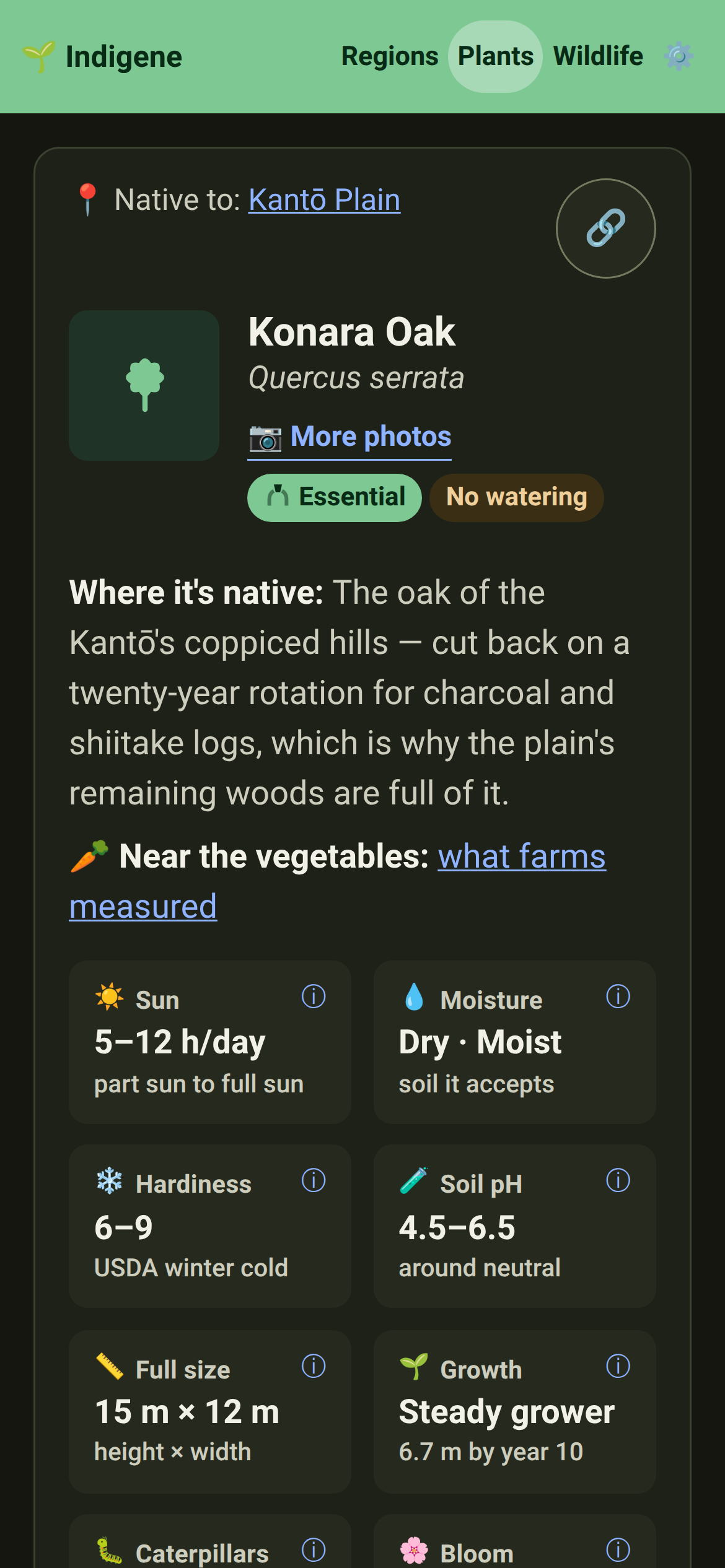
- Regions: Indigene reaches Asia. Konara oak, the tree the plain's old coppiced woods were built on, feeds 531 kinds of caterpillar here — more than any other plant in the app.
- Planting: the satoyama flora joins the catalogue — wild cherry, keyaki, bush clover, susuki grass. Enoki hackberry is the one tree Japan's national butterfly can raise its young on.
- The St Lawrence Lowlands are on the map — 55 native plants for Montréal, Québec City, Ottawa and the Champlain valley down to Burlington.
- Regions: a gardener in Sherbrooke, Granby or Ottawa used to be handed the Mid-Atlantic list, full of redbud and flowering dogwood that don't grow there. They now get the list for the valley they live in.
- Planting: American bittersweet, virgin's bower and sensitive fern join the catalogue. Bittersweet's orange capsules split to scarlet seed in October and feed waxwings through February, when nothing else is left.
- Wildlife: share a group page, like all the butterflies, and the link now previews with its own picture and counts instead of the plain Indigene card.
- Plants: how sure we are of a plant's figures is now a three-bar meter instead of a paragraph. Tap it for what each level means.
- Plants: confidence now follows one rule for every plant, set by where its caterpillar count comes from. Many American plants drop to medium or low — a sign of where we need better sources, not worse plants.
- A new page explains what "native" means here, and what it never means: where a plant evolved, not borders or people. It lists the words we stopped using and why, and what our own name meant in colonial France.
- Matches: "Add sighting" on a plant in your saved spot now shows your own iNaturalist photos of that plant. Tap one to add it, no link to paste, so each season's photo lines up under the plant to show how it's growing.
- Matches: got a planting date or count wrong? Tap "Edit" beside the date of a plant in your saved spot to fix it, and keep the sightings linked to it.
- Sightings of a plant show its drawing while their photos load, the way plant pictures already do, instead of an empty gray square.
- Matches: a saved spot's page can now rename the spot, or move its pin on the map when it landed next door.
- The home page has a one-minute, hand-drawn film about what Indigene does and who it's for, in English or French to match your language. Nothing loads from the video host until you press play.
- The film has a page of its own, in French too, made for sharing: send the link and the film shows up in the preview, playing right there in many chat apps.
- Regions: each region now shows a small flag beside its name, two where a region crosses a border, like the Pacific Northwest, so you can find your country at a glance.
- On a slow connection, pages no longer sit blank while the app arrives. A small seedling shows right away, and if the wait runs long, a word that it's still coming.
- Plants: the labels under a plant's name are a word or two now, like "No watering" or "Thorny", and each one opens its full meaning on the new plant traits page.
- Regions: every region page now ends with the native plant groups whose ground it is — plant sales, walks and advice from people who garden it. Three to five per region, chosen for the region rather than the country.
Changed
- Plants & Wildlife: a plant or animal native to three regions or more now says "Native to: 4 regions" — tap it (or point at it) for the list. Choosing another region's figures, or photos, works the same way, on one line.
- Plants & Wildlife: "See it near you" takes much less room. Your location, a ZIP code or a region where it lives now share one row, and the privacy link sits beside the intro instead of under the buttons.
- Plants & Wildlife: on a laptop, plant and animal pages fill both columns instead of leaving half the screen empty. An animal's plants now flow down two columns, region after region, and a plant's growth drawing sits under its photo.
- The welcome page's other way in fits on one line on a phone: "Or browse without sharing your location."
- The English now spells one way, the American one: color, gray, neighbor. Words most Americans don't use went too — "fortnight" is "two weeks", a "verge" is a roadside, a ladybird is a ladybug.
- Plants & Wildlife: notes no longer crown "the most valuable" or "the biggest" plant where two notes disagreed, and no longer talk about "this list" — they describe your garden, not our spreadsheet.
- The welcome page says what's true, more plainly: plants didn't evolve to feed birds, but local insects evolved alongside native plants, and many can eat nothing else.
- Sightings from iNaturalist now say what makes them trustworthy: at least two people agreed on what the photo shows. "Research-grade" and "verified" are gone.
- Regions: on a wider screen, a region's map sits beside its name and figures instead of alone under them, and the worst invasives sit three abreast.
- On a laptop, the home page puts the film beside the pitch, and Settings shows its cards two abreast. About, Privacy & safety and Where our numbers come from list their sections beside the text.
- The guide and What's new use a laptop's width too: guide topics two abreast, and each release's notes beside its name and picture.
- Matches: the buttons on a saved spot say what they do. "Open" is now "Plant more", and the link to what's in the ground reads "Already planted".
- The "Most-wanted invasives" lists are now called "Worst invasives", because nobody wants these plants.
- In French, invasive plants are now called "plantes envahissantes", the term French naturalists and the sources we cite use, instead of the anglicism "invasives".
- The French text reads more like French: dozens of phrases translated too literally from English now say what a French gardener would, such as « laissez-la sur pied » instead of « laissez-la debout ».
- Regions: a region page's worst invasives are one tap away, from a chip beside the plant categories at the top.
- Plants: the plants index opens with five short links — look-alikes, swaps, worst invasives, crops, growing more — instead of four paragraphs, so the search is on the first screen.
- Plants: a plant's page puts its "Figures for" region switch right above the figures, the photo link beside the photo, and a title on the growth drawing. Care and wildlife writing moved into two cards: Growing needs and Ecosystem services.
- Plants: figure labels are shorter in English and French ("Caterpillars", "Hardiness"), and a wrapped label no longer knocks its tile out of line. The "Year 10" tile is now "Growth": how fast it grows, then its height by year 10.
- Plants & Regions: "keystone plant" is now "essential plant" on labels, tiles and region counts — a plant local wildlife leans on far more than most. Ecologists' word for it is still there, explained, where you tap for more.
Fixed
- Sharing a plant shows its picture-card again, and 133 of those cards were quietly out of date — a maple that feeds two creatures said nothing about them. Every card now matches what the plant's page says.
- Screen readers now say what each emoji means here instead of its official name: 🚫 in "No thorns" is "no", not "prohibited", and ↗ says the link opens another site. French readers hear it in French.
- Plants & Wildlife: dozens of notes were corrected. A monarch needs a milkweed, not one particular milkweed; yerba buena means "good herb"; Europe has more than one green butterfly; a bushtit weighs about five paperclips.
- Plants: wild garlic now warns that every part is toxic to dogs and cats, and that its leaves look like two poisonous plants.
- Plants: the "deer tend to leave it alone" tag is off plants deer happily browse, like hemlock, Douglas-fir, wild roses and bramble.
- Invasives: two plants went by names that insult people. They're now "highway ice plant" and "Asian bittersweet", and each page says why in a line. Searching "sour fig" or "Oriental bittersweet" still finds them.
- Plant notes describe what an invasive does rather than where it's from: "invasive" instead of "invader", and "native here" instead of "belongs here".
- About: the page said Indigene runs no analytics, but a visit counter does. It now says so, and that you can switch it off in Settings.
- A few facts were wrong: chickadees need yards that are at least about 70% native plants (we had it backwards), butterflies do sip rotting fruit, and peppers come from Mexico, not the Andes.
- Keyboard focus now shows on the green header, the plant search no longer reads the whole list aloud as you type, and the date boxes on a saved spot have names a screen reader can say.
- The Guide and What's new links in the ⚙️ menu open the right page again from any plant or animal page, and Back now closes the photo viewer.
- Plant photos show up on the full plants list again, and while scrolling they now load where you've stopped first, instead of for rows you've already passed.
- Plants: on a plant native to several regions, tapping another region above its figures switches to that region's numbers again, and the page stays where you were instead of jumping to the top.