Added
- Native swaps: the everyday garden staples now have native answers too. Daylilies, hostas, periwinkle, maiden grass, garden roses and yellow flag iris each meet the native that does their job — so nearly half of every plant we recommend now names what it stands in for. See them
- Native swaps: a photo of each, and linked to the look-alikes. Every ornamental now opens with a real picture, and where one is also a plant people mistake for a native, the two pages link across — “tell it apart” one way, “grow a native instead” the other. See them
- Native swaps: now in French for Atlantic France. Every ornamental there and the native that betters it reads in French — what each plant is, and the side-by-side on the water it saves, the disease it dodges and the wildlife it feeds. Other regions follow. See them
- Southern California's list had no evergreen trees in it at all. Four are in now: Tecate cypress — the region's own, and the only food of one rare butterfly — with Torrey pine, Coulter pine and California juniper.
- Wildlife: the juniper & cypress hairstreaks join the catalogue. They are the green of the foliage they sit on, and their caterpillars eat cypress and juniper and nothing else.
- Regions: the three thinner French lists caught up. Mediterranean, continental and alpine France gained 44 plants — riverside willow and poplar, bramble, raspberry, winter heath, wall ferns.
- Regions: every one of those 44 reads in French the day it lands — what the plant is, how to grow it, how to propagate it, and a line for each animal it feeds.
- Wildlife: the orange-tip joins the catalogue. The male's bright wingtips are unmistakable; the female has none, and lays on cuckooflower in the damp corner people mow in June.
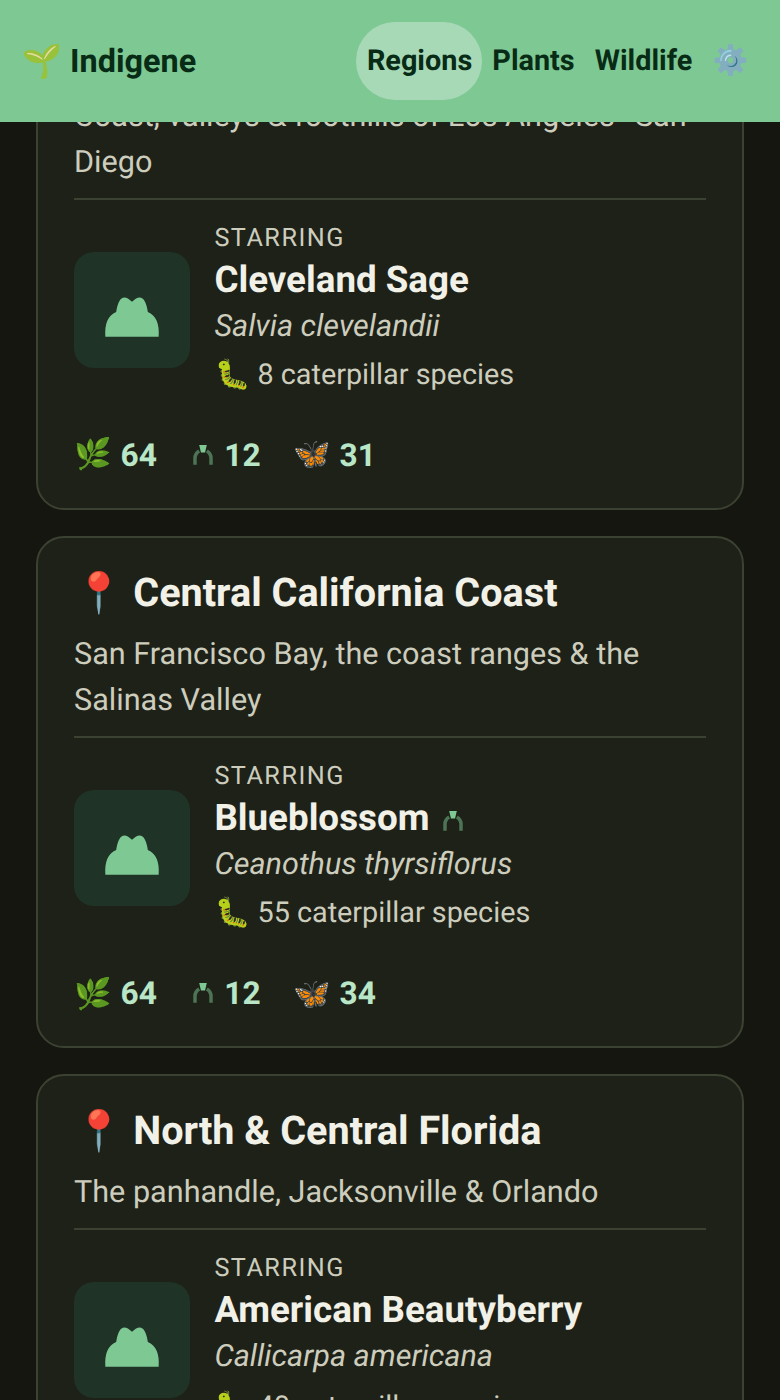
- Regions: the central California coast is on the map — 64 native plants for the country from Sonoma and Marin through San Francisco Bay to Big Sur and the Salinas Valley. See the region
- Regions & Wildlife: three creatures join the roster — the pipevine swallowtail, whose caterpillars eat one vine and nothing else; the lupine blues, the mission blue among them; and the chestnut-backed chickadee of the fog-belt forests.
Fixed
- Wildlife: the mourning cloak is native to Europe as well, where it is called the Camberwell beauty. Its page said North America only.
- Wildlife & Regions: the star that marks a plant an animal can’t live without now says the same word everywhere — “Vital.” It used to read “Essential” on the plant and “Vital” on the animal’s summary.
- A tab you come back to keeps its colours. A page left open for a day could come back washed out — the green header gone grey, the buttons blank — until you reloaded it. Indigene now spots that on the way back in and paints itself again.