Version 0.15
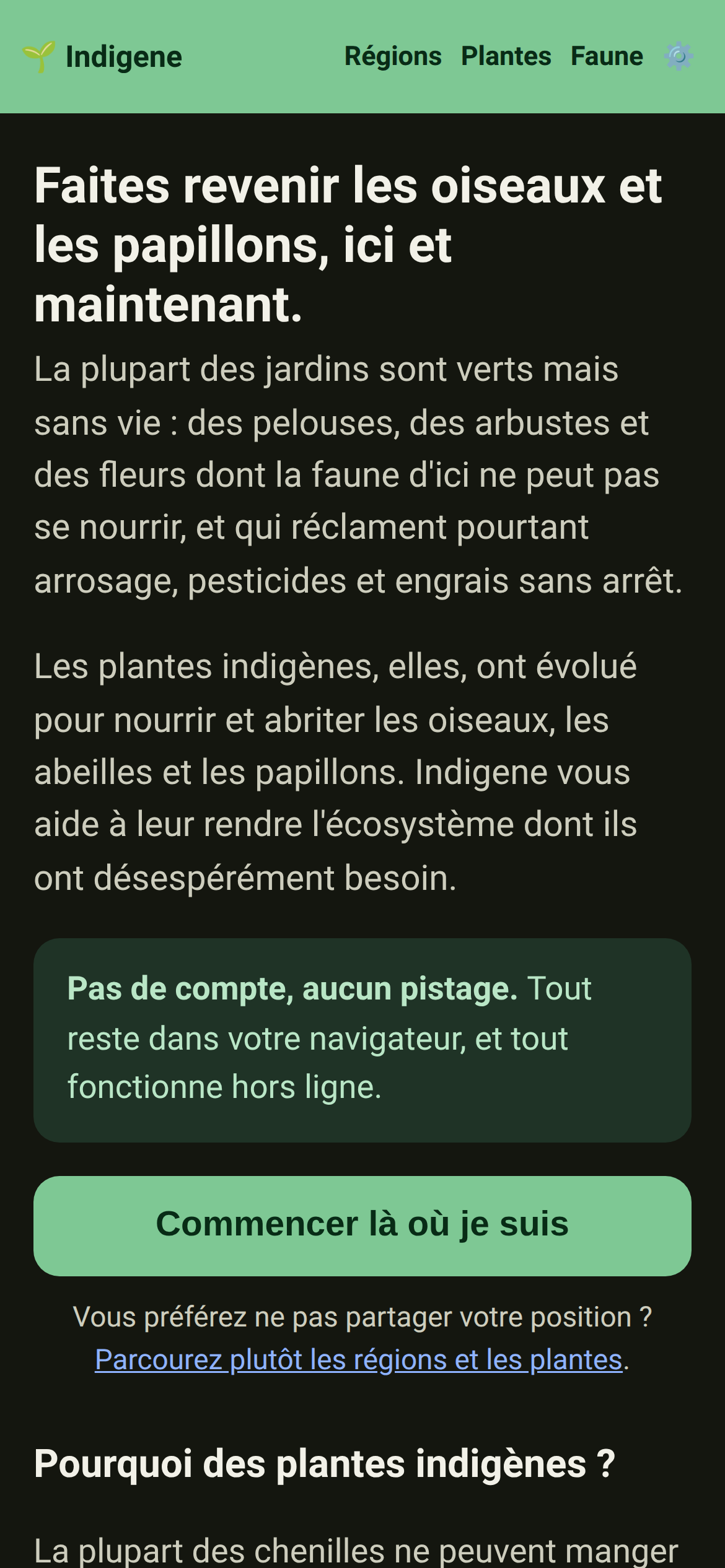
Indigene speaks French
July 30, 2026
Added
- Indigene speaks French. Every word of the app is now available in French as well as English. It picks your language from your phone the first time, and you can change it whenever you like from Réglages / Settings.
- You choose your own units, whatever language you read in. Metres and °C, or feet and °F — the choice is separate from the language, so a French speaker gardening in Ohio can read in French and measure in feet. See Settings.
- Plants and animals are called by their French names. Quercus robur is "Chêne pédonculé", because that is the name in France's own national list. Where nobody has given a plant a French name we show the scientific one rather than inventing one.
- Send someone a link that opens in French. Put
?lang=fron the end of any Indigene address and it opens in French for whoever you sent it to. It will never overrule them, though: a language they chose themselves stands. - The size drawing, the plant cards and the "no taller than…" filters all read in your units: "24 m × 21 m" or "80 ft × 70 ft", with the ruler marked in whole metres or whole feet — never the awkward converted numbers.
- Search engines are now told that Indigene exists in both languages, so a French-speaking searcher can be offered the French page.
- An About page, linked from the bottom of every page. It says why Indigene exists — most gardens are green and nearly lifeless — and the five things it refuses to do, including never using a word it hasn't explained.
- Browse by wildlife now has a "Filter by name…" box, the same one the plant lists have. Type "swallow" and the page keeps only the swallowtails.
- Each group of creatures also has its own page now — just the butterflies, just the moths, the bees, birds or mammals. A row of buttons hops between them.
- Pick a region on the wildlife page and see only the creatures that live there. Choose the Pacific Northwest and the list narrows to the 15 creatures its natives support. Every combination has its own address, like the butterflies of the French Alps.
- Your plant list for a spot has the same "Filter by name…" box. Type "oak", "milkweed", "fern", and the part you typed is underlined in green on each match. It searches the whole ranked list, not just the cards on screen.
Changed
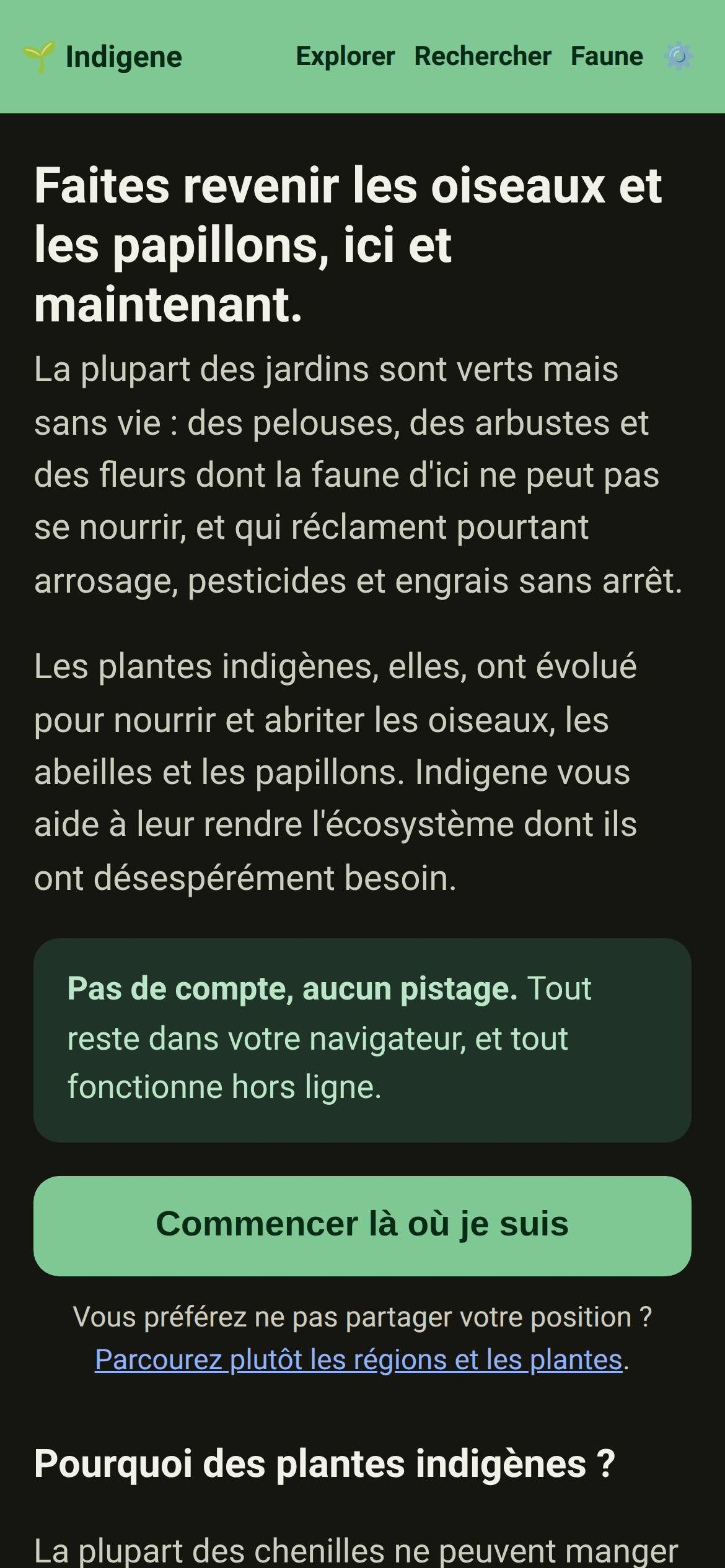
- The menu at the top of every page now says what each page holds. "Explore" is now Regions and "Search" is now Plants. In French the three read Régions, Plantes and Faune.
- The bookmark button is now a ⚙️ menu, holding your language and units as well as your saved spots. The setting that puts the app in your language used to be at the bottom of a page you might not be able to read.
- Language and units are two separate lines, in the menu and in the footer. A globe 🌐 for the language, a ruler 📏 for the units. Written together as "English · Imperial" they looked like one setting, and they have never been one.
- The home page no longer stops to ask about language and units halfway down. That belonged in the menu and the footer, not in the middle of the page you came to read.
- Sharing a plant is a small link button at the top of its page, beside the regions it's native to, instead of a full-width button at the bottom. It's in reach the moment you recognise a plant, and it no longer spends a whole row of a phone screen.
- Every creature now says where it lives, instead of wearing a "native" badge. Every animal on these pages is native, so the tag told you nothing. A creature found in more than one region now shows a pin and a number — 📍 3 for the monarch.
- When you filter a region's plant list — say you type "oak" on Florida — the part you typed is now underlined in green, exactly as it already was on the plants page.
- Your plants come sooner on the page. The explanation of how the ranking works used to sit open above the list, so every visit began with five lines about method. It now waits inside What matters most?, where you'd go to change it anyway.
- The buttons on your plant list moved below the plants. "Back" and "Save this spot" used to sit above the list, so the first thing on the page that finally shows your plants was a way to leave it.
- The French plant descriptions for Atlantic France — Paris, Nantes and Bordeaux — are written in French. Other regions are still in English while we work through them, and any page showing English says so plainly.
Fixed
- Reading in French, being answered in English. The sentences Indigene writes for you personally — "Sun is a good match", "Winters here are too cold for it" — were still coming out in English. They now follow your language, and your units. Try white oak.
- "Fleurit de avril" — the flowering line said de avril, de août, which is not how anyone writes French. It now reads Fleurit d'avril à mai, with the months spelled out in full.
- The little line under each nearby sighting — how far away and how long ago — was English-only, and always in kilometres. It now follows both your settings: "à ~3 km · vue en juin 2023", or miles. So do the descriptions read out by screen readers.
- A page full of English no longer keeps quiet about it. Every page that still has English on it now carries a banner in yellow-and-black hazard stripes: "Traduction en cours". You see it before you meet the English, not after you've wondered about it.